Start of Capsule #0002
This week, the Mozilla Foundation launched an advertising campaign against the tech billionaire class1 — and I am featured in it. One of the posters, plastered on walls in New York, places me alongside Mark Zuckerberg: he builds surveillance glasses and makes it easier for creeps and abusers to commit more crimes. I, on the other hand, build local artificial intelligence to expose violence in Brazil — a project in partnership with the Fogo Cruzado Institute2. I am writing about the campaign not as a neutral analyst, but as a subject of the piece itself — and it is precisely from this dual position, as someone who is part of the very object being analyzed, that this text begins.
The layout of the pieces is worth noting. Each poster follows a triad: in the first one, a billionaire — Zuckerberg with his watchful glasses, Musk buying and dismantling the blue bird, Bezos launching celebrities into space. The second shows an ordinary person building an alternative: local AI to expose violence, decentralized social networks where communities make the decisions, and democratic tools that empower Kenyan voices3. And the third offers a collective conclusion: “The powerful shouldn’t choose what we see. We all decide.” The composition is deliberate — equal size and visual weight given to both the billionaire and the builder — but it is in the grammar that the operation is fully realized: the sentence’s subject shifts from the singular owner (Mark builds, Elon buys, Jeff builds) to the constitutive plural (we all decide, we all do, we all will). It is not a clash of individuals, with a hero replacing a villain, but rather a rejection of the very mythology of the lone genius — swapping the question “Who will be the next Steve Jobs?” for “What can we build together?”. This, in an advertisement, is almost a theoretical manifesto condensed into a promotional piece.
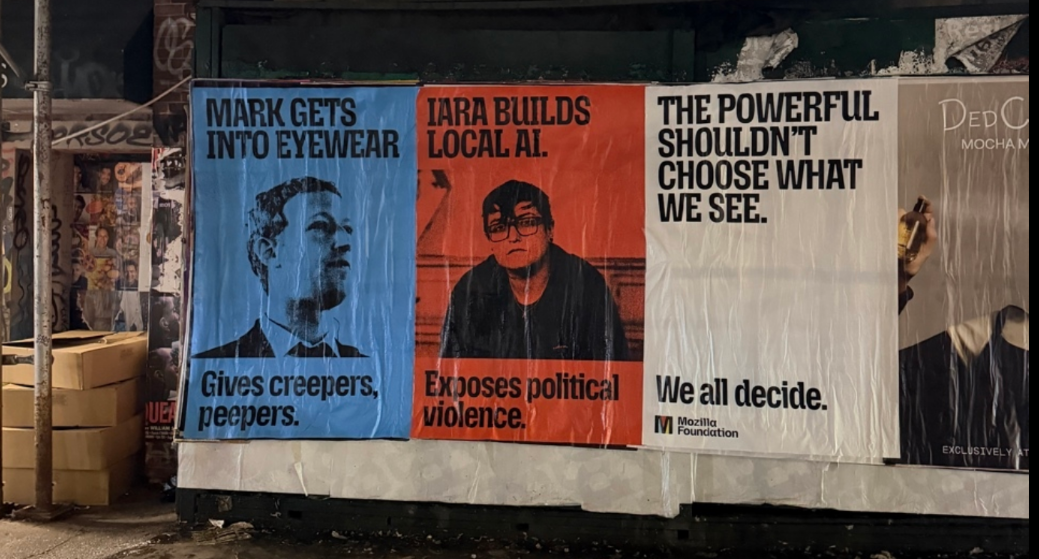
“Mark gets into eyewear / Makes creepers, peepers. Iara builds local AI. Exposes political violence. The powerful shouldn’t choose what we see. We all decide”
The timing is not accidental. In Brazil, amidst the presidential election campaign, the primary warning concerns neither the possibility of ballot fraud nor threats to electronic voting systems. Instead, Brazilian intelligence assessments4 focus on a different terrain: economic pressures, sanctions, diplomatic measures, and the construction of narratives capable of influencing domestic political debate and impacting companies, institutions, and individuals through the financial system, foreign trade, and sanctionaries measures. It is not merely a matter of the disinformation circulating on platforms — that is the superficial, the most visible layer. It involves something more structural: moderation and amplification decisions made in California boardrooms that alter what Brazilian voters see, debate, and believe and, increasingly, biased AI assistant responses delivered ready-made to those seeking help in deciding how to vote. If the arena where a democracy takes shape belongs to foreign private owners, voting is not about choosing representatives — it is about consenting, or not, to those who define what can be said, seen, and debated. And no one warned us that this was the game. The question of who controls communication infrastructure has moved beyond a niche debate on cyberculture: it is now a matter of elections, public security, and sovereignty.
In the early days of the World Wide Web, cyberspace was often envisioned as a horizontal frontier: a rhizomatic, decentralized network where corporate hierarchy would dissolve through the free flow of information. Yet, within a few decades, the monopolistic hegemony of Big Tech instilled in the public an almost total inability to imagine how global communication, civic infrastructure, media consumption, and data research could function outside the “walled gardens” of these megacorporations.
I consider this condition as Platform Realism (a combination of Capitalist Realism, by Fisher5, and Platform Capitalism, by Nick Srnicek6). Like Mark Fisher’s capitalist realism — the widespread sense that capitalism is the only possible system, so much so that “it is easier to imagine the end of the world than the end of capitalism” — Platform Realism operates through a double dissimulation: it presents its infrastructures as neutral, transparent, and inescapable tools (mere organic extensions of human neurological and linguistic capacity), while it actively shapes the texture of reality to make civic and economic survival impossible outside its domains. Despite widespread unease regarding the erosion of privacy, the proliferation of misinformation, and the degradation of mental health, it has become cognitively absurd for the majority of the global population to consider a world without these platforms as a political possibility. It’s easier to imagine the end of the internet than the end of them.
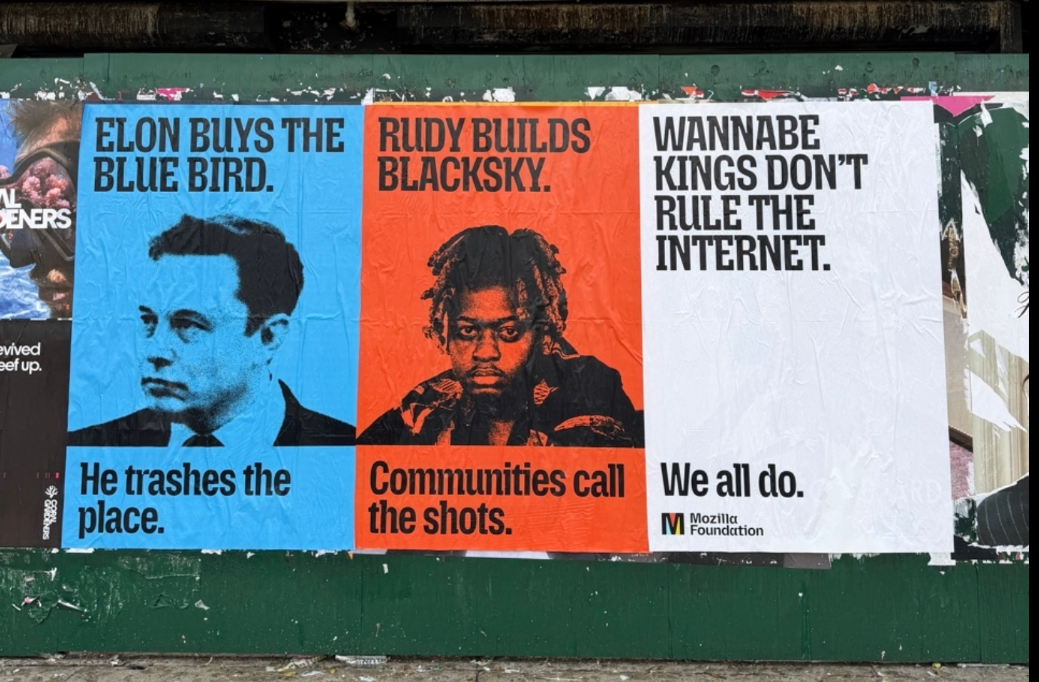
“Elon buys the blue bird. He trashes the place. Rudy builds Blacksky. Communities call the shots. Wannabe kings don’t rule the internet. We all do.”
It is here that Fisher becomes an analytical instrument, through the concept — inherited from Derrida7 — of hauntology: a time haunted by lost futures and anachronistic persistence of the past. It is not uncommon to find, in those who lived through the heyday of the open internet, mourning for a future that seemed imminent: a network that would empower collectives and individuals, expand worlds and possibilities. The “slow cancellation of the future”8 physically manifests itself in the implosion of cultural time: contemporary pop culture is defined by compulsive repetition, the fetishization of the archive itself, and a pastiche emptied of revolutionary context. What those who dreamed of the open web experience as personal loss is, in fact, the collective symptom of this haunting: the future has been canceled, but it still haunts us.
Thus, if social networks fragment the civic fabric through stress and resentment, the algorithmic architecture of audio, video and entertainment distribution platforms acts simultaneously as an executioner and embalmer of aesthetic innovation: it kills the possibility of the new and preserves, taxidermied, the form of what once was. This is what we see being revived in trends that are bombarded in our laps from time to time: AI-generated images that show what we would have looked like in the 80s, recreations of old photographs, filters that rejuvenate faces, the polaroid aesthetic reinflated with each cycle. And when the national archive comes into play, the phenomenon takes on an almost caricatured shape. This is the case of Blow Records9, which produced with AI versions of funk from Rio in the style of songs from the 60s, 70s and 80s — boogie, disco, funk — and the result went viral from Europe to Asia, with proibidão10 lyrics echoing in restaurants and stores around the world, to audiences who don’t understand a word of what is being sung. The algorithm produces nothing — it embalms and rearranges. And the result is a strange nostalgia for times that many of us didn’t even live through or that simply never existed: cooked up on demand, delivered in portions calibrated by engagement. The new became expensive, risky. The recycled, cheap, purposefully viral and falsely perfect past. No vanguard survives this economy: only the archive, regurgitated.
Given this diagnosis, what is left to do? If Platform Realism operates primarily as a capture of the imagination, making life outside the walled gardens unthinkable, then the primary battleground is neither the regulatory nor the technical, but the imaginary: the collective capacity to conceive alternatives. And that’s precisely where Mozilla’s campaign gets it right. By placing side by side, in the same size and on the same wall, the billionaire tech bro who surveils and the fellow who builds local artificial intelligence to map violence, the poster constructs the central argument of Fisherian hauntology in the opposite direction: not to haunt the present with the lost future, but to desacralize the present with the possible future. The message is that the alternative is not a utopian abstraction — it already exists, it is working, it has a name, surname and face, and it fits in the exact space that the mythology of genius occupies today. In this sense, the campaign does not advertise a product, but rather is an advertisement for the imaginative horizon itself. It does the deliberate work of remembering that there are more people building than buying — and that this decentralized, collective and everyday construction — open protocols, local AI, civic verification tools — is the true technological engine of our time, even if made invisible by the billion-dollar spectacle. The exit is, first and foremost, collective.
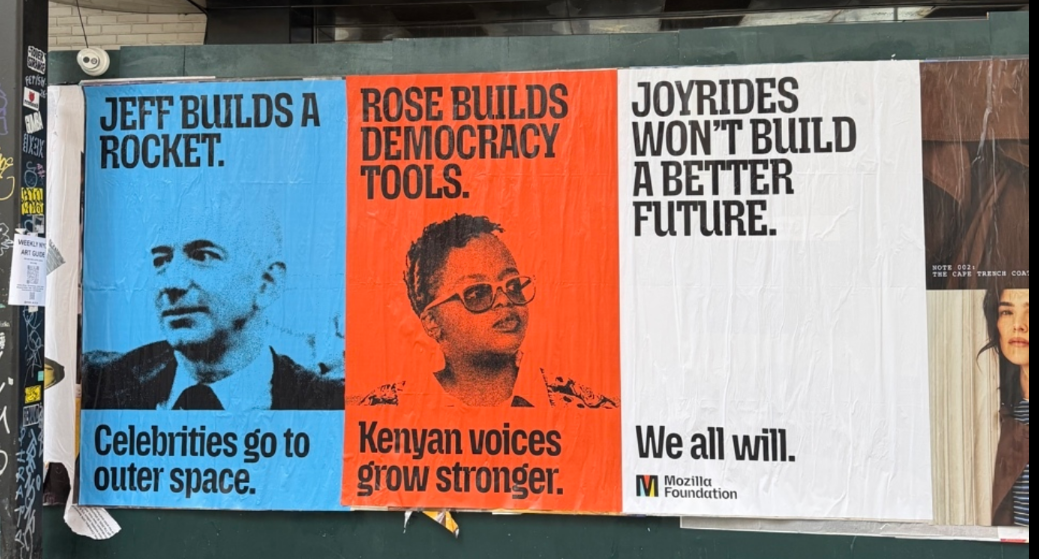
“Jeff builds a rocket. Celebrities go to outer space. Rose builds democracy tools. Kenyan voices grow stronger. Joyrides won’t build a better future. We all will.”
Someone will say that resistance has also become marketing, that even culture jamming11 is captured by symbolic capital and that, thus, even the poster itself is a commodity of the system it denounces. Perhaps. But criticism of the format cannot exclude the content: no advertising ambiguity erases the fact that, in the middle of Manhattan during UNGA week12, thousands of passers-by stumbled upon the right question. And many will still be affected on social media.
In a Brazil during an electoral period, where the interference of foreign platforms in the democratic process is daily news, this gesture has specific weight. Remember that the communication infrastructure is not the natural destination of Big Techs, but disputed territory — and that, in the disputed territory, the first act of sovereignty is to refuse the premise that there is no alternative. What the slow cancellation of the future tried to kill is still alive: it survives, distributed and operative, in each project that points outside the walls that the broligarchy tries to impose on us.
The future is not missing — it’s missing from our imaginations. The future is not missing — it’s missing from our advertising.
Fortunately, this week, it wasn’t.
End of Capsule #0002
Note: This text was originally published in portuguese, my mother tongue. Because this text was originally composed in Portuguese, some words, expressions and meanings may have shifted or lost their force in translation.
References
BUSINESS INSIDER. Mozilla is plastering New York with posters mocking tech billionaires as part of a new marketing campaign. https://www.businessinsider.com/mozillas-new-ad-campaign-features-posters-criticizing-big-tech-execs-2026-9 ↩︎
INSTITUTO FOGO CRUZADO. https://fogocruzado.org.br/. ↩︎
Mozilla fellows. https://www.mozillafoundation.org/en/what-we-do/grantmaking/fellowship/2026-mozilla-fellows/ ↩︎
CNN Brasil. Governo vê interferência dos EUA em eleição brasileira por quatro frentes. https://www.cnnbrasil.com.br/blogs/caio-junqueira/eleicoes/governo-ve-interferencia-dos-eua-em-eleicao-brasileira-por-quatro-frentes/ ↩︎
FISHER, Mark. Realismo capitalista: É mais fácil imaginar o fim do mundo do que o fim do capitalismo? Trad. Rodrigo Gonsalves, Jorge Adeodato e Maikel da Silveira. São Paulo: Autonomia Literária, 2020. https://autonomialiteraria.com.br/loja/teoria-politica/realismo-capitalista/ ↩︎
SRNICEK, Nick. Platform Capitalism. Cambridge: Polity Press, 2017. ↩︎
DERRIDA, Jacques. Espectros de Marx: o estado da dívida, o trabalho do luto e a nova internacional. Trad. Anamaria Skinner. Rio de Janeiro: Relume Dumará, 1994. ↩︎
FISHER, Mark. Fantasmas da minha vida: escritos sobre depressão, assombrologia e futuros perdidos. Trad. Guilherme Ziggy. São Paulo: Autonomia Literária, 2024. https://autonomialiteraria.com.br/loja/filosofia/fantasmas-da-minha-vida-escritos-sobre-depressao-assombrologia-e-futuros-perdidos/ ↩︎
BLOW RECORDS. https://www.youtube.com/@BlowRecordsBR ↩︎
Funk proibidão (or simply proibidão) is a raw, explicit subgenre of funk carioca that emerged in the favelas of Rio de Janeiro in the early 1990s. It is characterized by lyrics that openly narrate the realities of drug trafficking, gang warfare, police violence, and sex. ↩︎
Culture jamming (sometimes also guerrilla communication) is a form of protest used by many anti-consumerist social movements to disrupt or subvert media culture and its mainstream cultural institutions, including corporate advertising. It is often described as a way of drawing attention to the methods through which mass society and media institutions shape public perception. https://en.wikipedia.org/wiki/Culture_jamming ↩︎
The UNGA (acronym in English for United Nations General Assembly), or UN General Assembly, is the main deliberative and policy-making body of the United Nations. ↩︎